From Landfill to Living Design
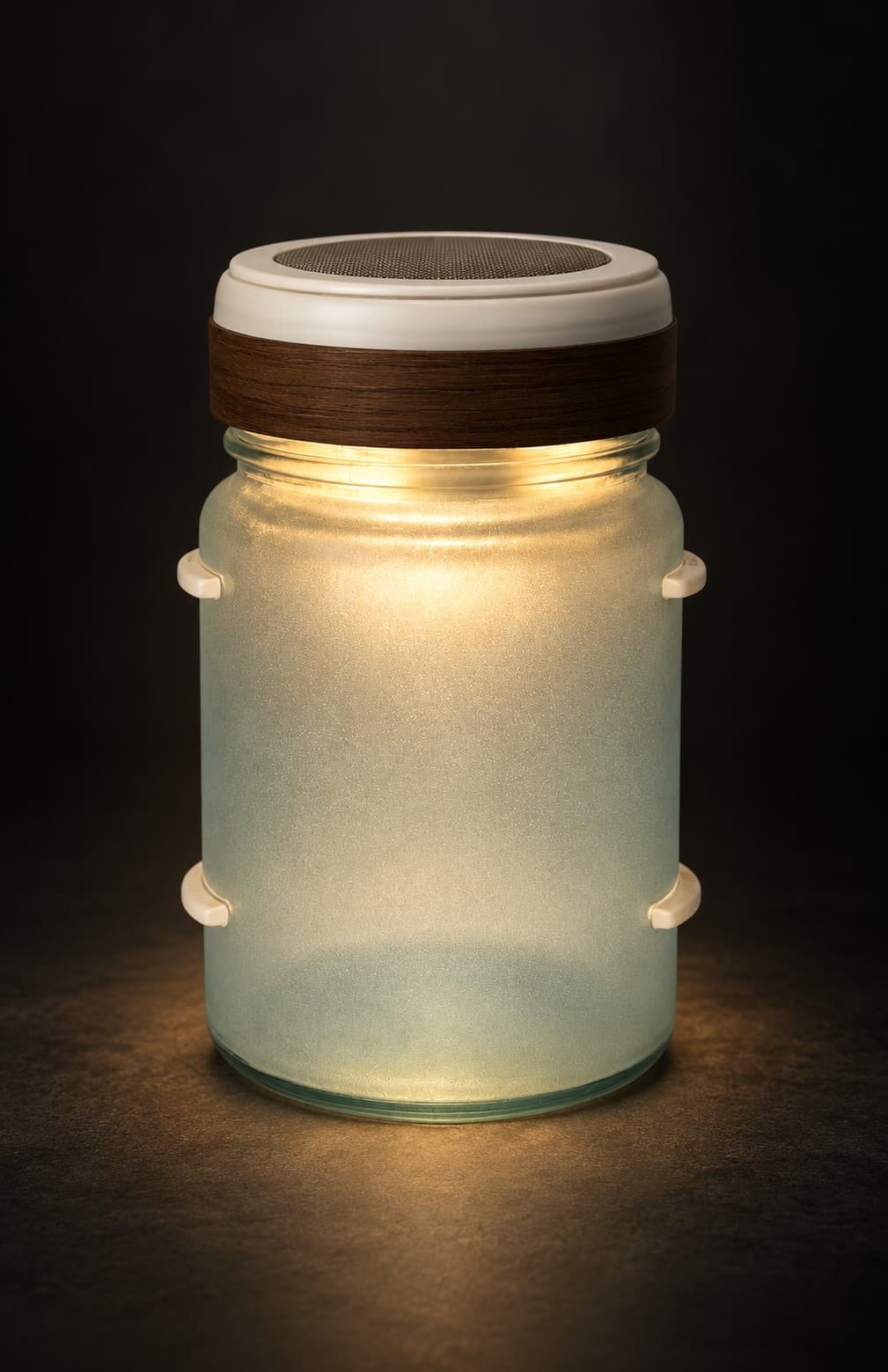
A Bluetooth speaker and lamp built into a discarded glass jar. Only about 31% of glass produced each year gets recycled that year; this gives some of the rest a second life.
- Role
- Lead organizer, lead design and build
- Year
- 2026
- Tools
- SolidWorks, 3D printing, Soldering
- Peak output
- 115 dB
- At 3 ft
- 65–75 dB
- Ambient light
- 30 lm
- Unit cost
- $15.69
First-year engineering design project at NC State, built by a team of four. The question we set ourselves was how to reduce glass waste while making something people would actually want in their home, because a sustainable product nobody wants is just landfill with extra steps.
Only about 31% of the glass produced in a year is recycled in that same year. Rather than ask someone to choose between sustainability and function, the design puts décor, ambient lighting, and Bluetooth audio into one object built around a jar they already own.
We surveyed 28 people before prototyping. 93% said they or their family had reused or recycled jars before, 79% already owned a Bluetooth speaker, and 82% rated the concept between 3 and 5 out of 5 for appeal. The average price they called premium but reasonable was $63.22.
That set the target. We priced at $60 to sit under it, against an estimated unit cost of $15.69.
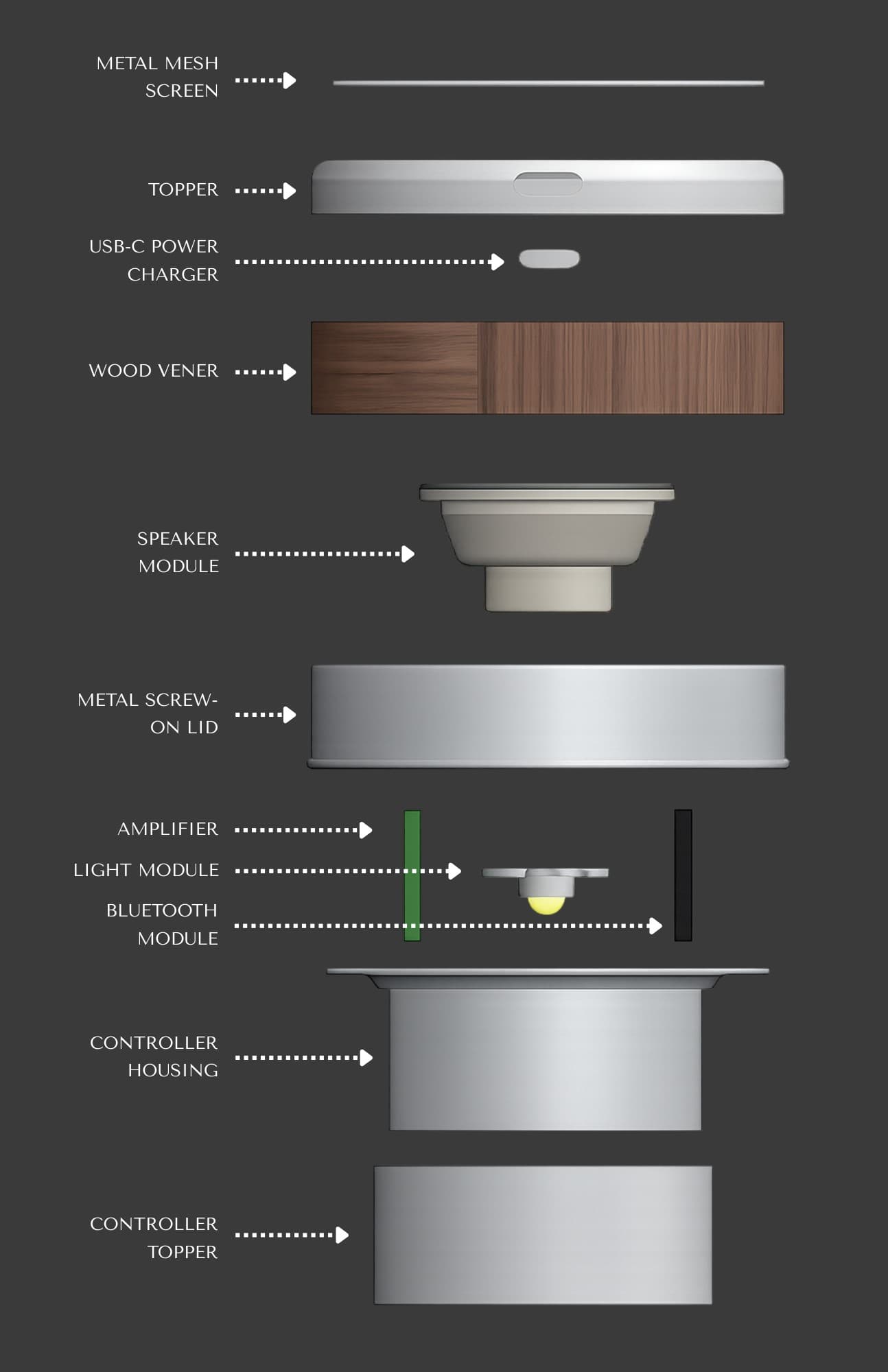
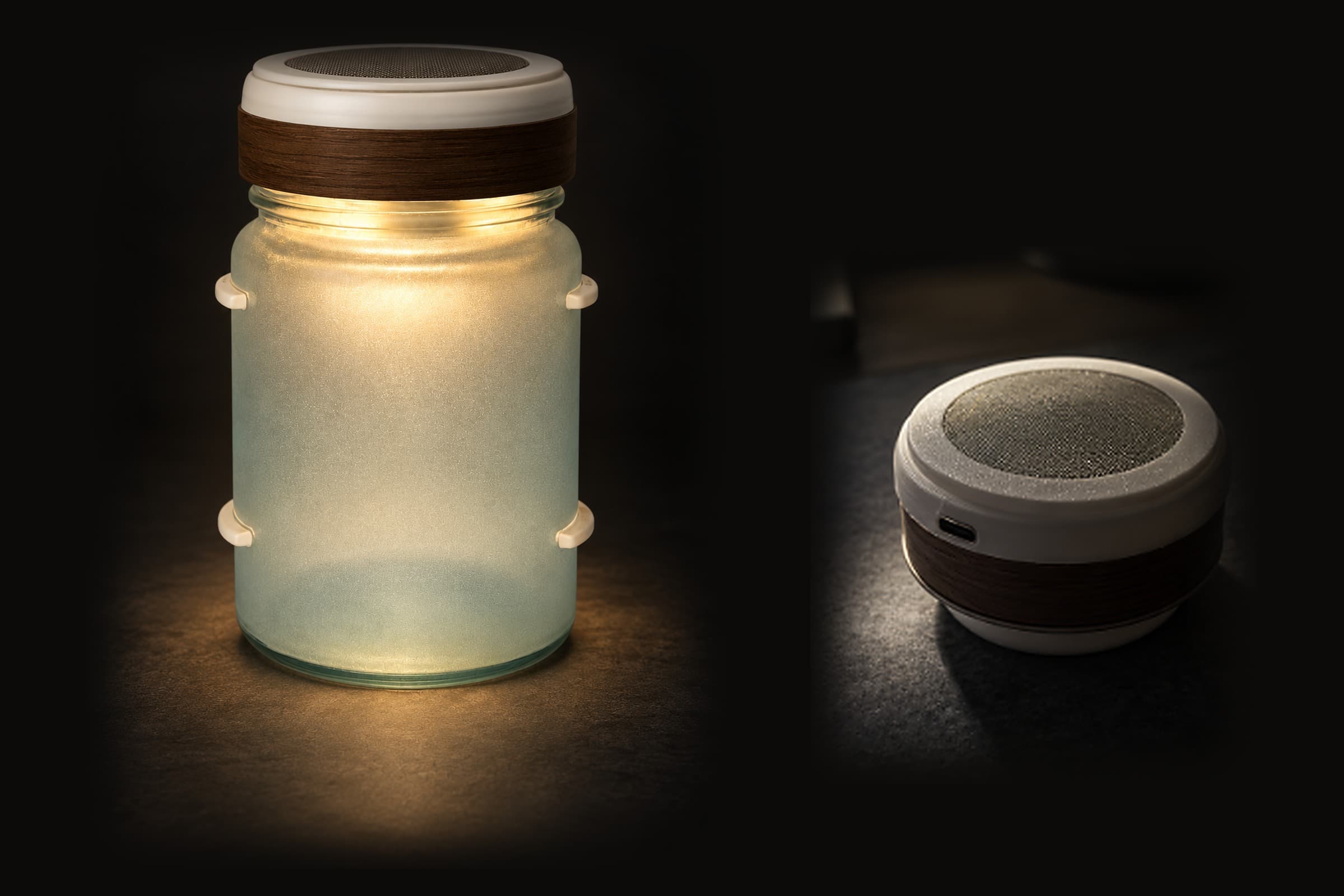
Everything lives in a modular puck that screws onto a standard jar lid: a metal mesh screen, topper, USB-C power, a walnut veneer band, a 3W driver, the screw-on lid, then the amplifier, light module, and Bluetooth module stacked into the controller housing. Making it a puck rather than a fixed assembly means it moves between jars.
Electrically it runs off a single USB-C 5V supply through a switch to the amplifier, Bluetooth receiver, and a 4Ω driver, with the LED on its own resistor leg. It reaches 115 dB peak, 65 to 75 dB at three feet, and 30 lumens of ambient light with touch capacitive control.
Fitting all of it into a housing that still looked like a lid. Running both the audio and the lighting off one 5V source without the light circuit putting noise into the speaker. Keeping the wiring clean enough to be reliable when the whole thing gets unscrewed and moved.
We used a prebuilt lid rather than machining our own, which cut a lot of complexity out of the assembly and let us spend the time on the parts that mattered.
People read it as décor and atmosphere first and a speaker second, and rated it 4.5 to 5 out of 5 on looks, so the design was never the limitation. Most said they would buy it as a gift rather than for themselves.
The consistent ask was more light. It is tuned for sleep-friendly ambient glow, which is too dim to do anything in daylight. Next version gets brighter output, an adjustable brightness dial on the puck itself, and a second size.